Notable Summer CD: Organist John Cannon

John Cannon at the organ. Photo credit John Cannon

Should performers try to capture the composer’s original vision for a piece? As an audience, do we expect them to? It’s a complicated question if the composer is still alive. It becomes a scholarly question if, say, we’re talking about Bach.

A couple of weeks ago I met John Cannon, a gifted and insightful organist, and our conversation turned from John Cage and maintaining a piece’s integrity to a war horse in the organ canon: J.S. Bach’s Toccata and Fugue (BWV 565). Should this piece be played as we imagine Bach intended, in the traditional Baroque style, adhering to all original notation as closely as possible? Or is it rather an organic, living work of music, open to each performer’s artistic interpretation?

It’s a question that Dallas audiences bickered over in January after a concert at the Meyerson Symphony Center, when Cameron Carpenter—an organist with an edgy reputation to say the least—performed a recital program made up almost entirely of Bach. Scott Cantrell, the music critic for The Dallas Morning News, called it “bizarre” and “grotesque,” citing Carpenter’s liberal interpretations as “ugly” and “inappropriate.” Arguments ranged widely, attacking both Carpenter and Cantrell without any clear winner naturally. Who can say, after all these centuries of wondering, what is universally pleasing and objectively beautiful? The better question is about integrity: should Carpenter have shown a little more reverence to the composer’s original intentions?

When it comes to Bach, Cannon falls on the opposite end of the spectrum from Carpenter. He sent me a sneak peak of his forthcoming CD, which is set to be released on the Raven label by the end of 2015. There’s a reverence to each note, as though each were carefully planned. But this doesn’t mean there’s not passion, too, in Cannon’s performance, which communicates a deep spirituality.

Cannon, who currently works as the organist and choirmaster at Christ Episcopal Church in Cooperstown, NY, recorded the CD on Colorado State University’s 1968 Casavant Frères organ. When it was installed, the Casavant was the largest mechanical action organ built in the 17th and 18th century style of North German organs at a university in the United States. The fact that the organ does not have an expression pedal hardly hinders Cannon’s poignant delivery of the more romantic pieces.

On the CD, Bach’s Sechs Schübler Chorales (a collection of six organ chorales that are transcriptions from his cantatas) and Concerto in A minor (BWV 593) seamlessly complement Georg Muffat’s Toccata Prima from Apparatus musico-organisticus and Mendelssohn’s Sonata No. 3 in A major—an organ classic. In addition to the old masters, Cannon plays Andrew Clarke’s Chorale Partita on Ein feste Burg—a set of eight variations that ring out and wind around the opening phrase colorfully. Bright when need be, reflective and quiet at other moments, Cannon’s style is versatile and technically sound.

But the standout on this CD is Jehan Alain’s Postlude pour l’office de complies. Composed in 1930 with the Office of Compline in mind—a service sung at night by nuns bathed in candlelight—the Postlude bespeaks memory as much as hallowedness. Cannon notes that Alain sought to prolong the feeling of the ceremony by using the free rhythm of the Gregorian chant—irregular divisions within bars and rhythmic independence with berceuse-esque accompaniment. Cannon points out a sense of rhythmic liberty here, as a result, and it comes across serenely in his performance.

Of course every performance will always be unique. There’s also no way to ask Bach what he intended—and if we could, even he might remember a piece differently from when he first composed it. I tend to give license to the performer. A work of art is out of the artist’s hands the moment they finish it. But there’s something refreshing, too, in hearing music as it might have sounded hundreds of years ago, or even just a century. Certainly, on this CD Cannon makes a strong argument for hearing Bach, simply as Bach.


Look out for the CD’s release later this year on the Raven Label.

Cannon's first visit to the Casavant oran. Photo Credit John Cannon
Cannon’s first visit to the Casavant organ. Photo Credit John Cannon

Form and Story: Laurie Anderson at UH

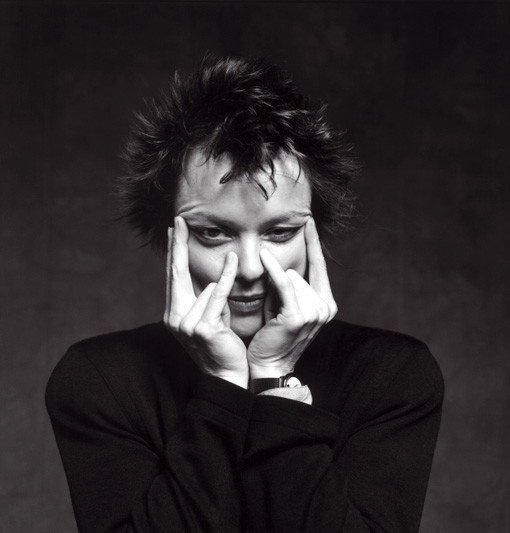
Laurie Anderson resists categorization. The Mitchell Artist Lecture is an annual event that aims to bring “icons of the avant garde” to the University of Houston. And you can read the long list of reasons why Anderson fits this bill on Wikipedia, but on Wednesday night at the Moores Opera House she embodied a more complicated set of questions the twentieth century has asked about music and art on the whole. She opened her lecture by stating “I’m going to talk about a few of those things I supposedly do, but really…I’m a storyteller…I’m going to talk about some ways I try to jam those things into different forms.”

Why do we need categories? Anderson spoke about the “Art Police” commanding “Get back into your category!” She was reminiscing about the 1970s, when “Nobody really knew what they were doing…We just tried everything.” The borders between what they—Gordon Matta-Clark and Philip Glass, to name a few—were doing, though, remained flexible. “Nobody ever asked me what I wanted be as a kid,” Anderson joked, “So I never decided.” Here Anderson presses against an on-going struggle, particularly in the critical sphere, to define something by placing it in a box with a specific heading: opera, musical, symphony; sculptor, writer, composer. Her interdisciplinary body of work (and that is an understatement) forces us to deal with a more repressed question: what is at stake without the box?

Why does form matter? Once performing on the street in Italy,  Anderson stood in ice skates that were frozen into a block of melting ice, and she played the violin until the ice melted, leaving the duration of her performance up to the elements. The revolutionary aspect of compositions in the twentieth century begins with tension between content and form of a work. The inventions of the twelve-tone scale, tone rows, and matrices in the early half of the century are philosophical experiments in how content is generated, and we can look to Arnold Schoenberg, a pioneer of atonal music, as a yet unwavering exceptionalist figure of the Composer. In the latter half the century, though, chance-generated work radically removed a composer from her work. Indeed, John Cage, a student of Schoenberg, sought to free the content of his music from individual (or the “Composer’s”) likes and dislikes. But it’s not a free-for-all. In chance-generated work the content is unrestricted, but the form is often inflexible. The developing relationship between form and content in Anderson’s work shows an inkling of the future: will form still matter?

How does storytelling relate to form and content? Throughout the evening, Anderson read several stories and told several others off the cuff—some of which she finished and some she left dangling without conclusion. It made her lecture seem disorganized, but the form her lecture took represents an important concept of telling stories. Think of Robert Ashley’s Perfect Lives, for example. Ashley’s investment in American storytelling instigated a move to television—a trailblazing move for opera especially. But someone watching Perfect Lives for the first time will likely have trouble grasping its plot. Instead, we recognize the characters, and this familiarity ties it all together into a story. For Anderson, a story is a set of links: “String something together and call it a story…often I’m very suspicious of those kinds of things, but we all have our stories about our lives,” she said. As such, it’s fascinating to think about what it means for storytelling—an ever-expanding category in itself—to be the inflexible form of Anderson’s work.

A wise person chose David Eagleman, a neuroscientist interested in time perception, to introduce Anderson. Anderson’s stories ranged from ducks in ponds to watching friends die and Vipassana meditation retreats in the mountains—all deeply reminiscent. Many of the films Anderson showed ran in reverse, emphasizing varied states of passing time. At one point she stated, “Every time you tell [a story], you forget it more,” implying, too, that as memories fade they grow into stories with a life of their own. Perhaps time, memory, life, and death raise the largest set of questions, too many and too varied, that stretch throughout civilization far beyond the twentieth century—questions that have yet to be answered in any discipline.

A New Make


Alex Waterman, director of Robert Ashley’s Vidas Perfectas, introduced tonight’s performance by remembering what Ashley said to him about re-making his television opera Perfect Lives: “Don’t sell them a used car–make them a new one.” The performance tonight in Marfa, TX, of the Spanish-language version was classically Ashley while inhabiting a vital new magic.

Whether you know Ashley’s operas or not, keeping old opera new is a popular topic right now.  The Economist‘s opera blog posted a piece just last week about Sir Mark Elder’s vision of a La Traviata at this year’s Glyndebourne festival that, he promises, will be new, fresh, and full of exciting discoveries. A tough promise for such an old work. And as the comments show, opera lovers fall passionately on either end of the spectrum about new and old works (and how those distinctions are defined) and staying true to the composer’s intention (whatever that might mean).

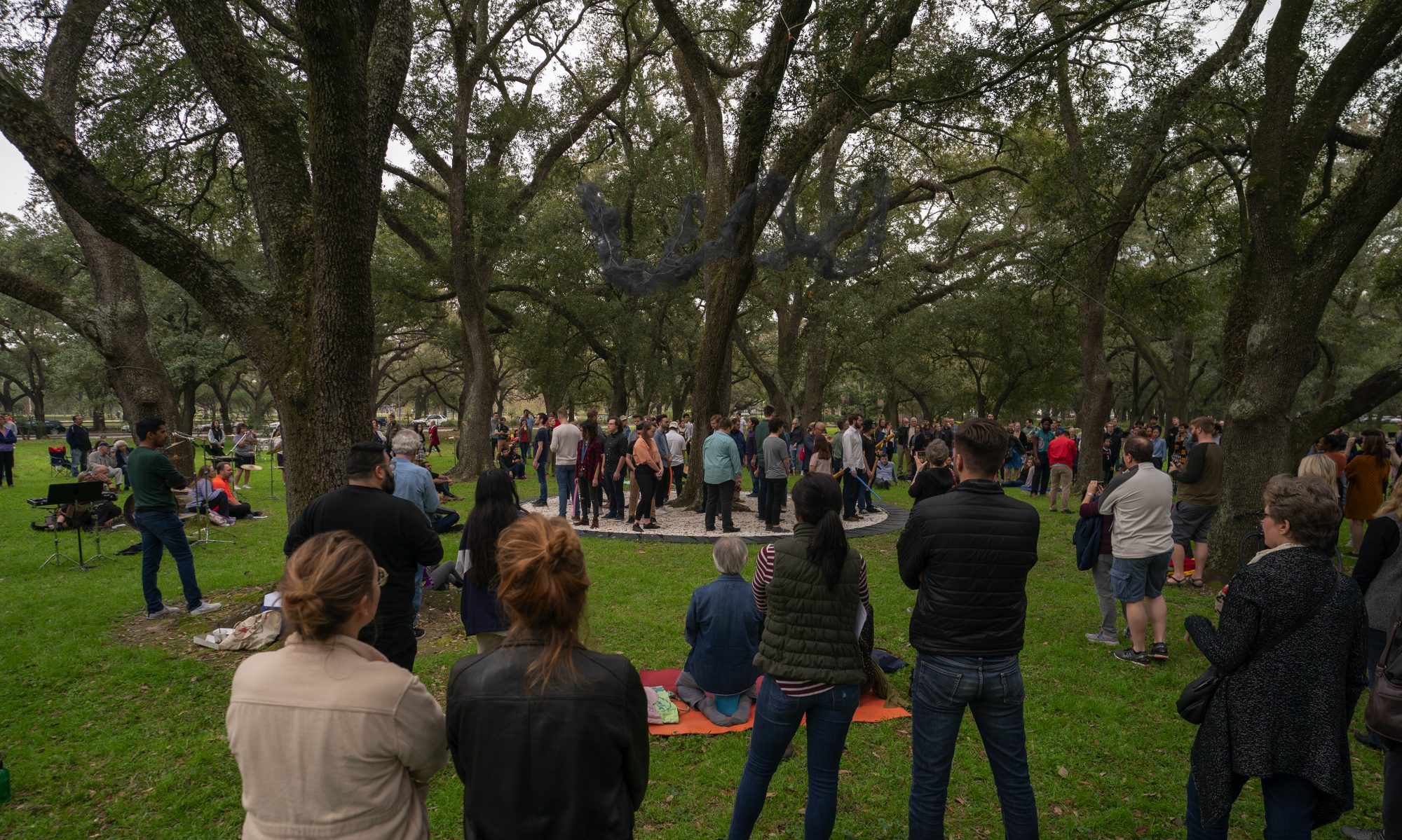
Tonight was the final performance of a four-night tour through west Texas, and the finality added an energy akin to a last hour spent with a loved one.  The fearless and talented Ned Sublette, Elio Villafranca, Elisa Santiago, and Raul De Nieves performed the last three out of seven episodes: El Parque (The Park), El Bar (The Bar), and El Patio De Atras (The Backyard). El Parque opened quietly. A strong groove had the floorboards shaking with unconsciously tapping toes by El Bar. But El Patio De Atras was truly spell-binding. Behind a row of old Panasonic televisions, the stage was framed by powerfully colored hanging banners–orange, purple, turquoise, red–that met at the back in two blocks of green. In the last act, these two green blocks opened slowly to the outside where Santiago was standing in a spotlight dressed in a floating gown alone. It was beautiful.

Ashley died this March, but if this production says anything it is that he is very much still alive. Near the end of his introduction, Waterman dedicated the performance to Mimi Johnson and Ashley, saying “They were supposed to be here tonight, but they couldn’t make it”–as though something had just come up in Ashley’s schedule. It was a fitting statement given how strongly Ashley’s influence comes through in this production. It may be a new car, but it still has the peaceful ingenuity I love in Perfect Lives. How much is Ashley and how much is Waterman–that’s harder to say. Who knows what some time will do to this work. What will Perfect Lives look like in 2050? I’m not sure, but I can’t wait to find out.


Summer Intermission: Some Notes

As the summer opera-hiatus drags on—alas, will October never arrive?—a few notes:

Opera is not far away! Alex Waterman directs the late Robert Ashley’s Vidas Perfectas over two weekends in west Texas. Vidas Perfectas is a Spanish iteration of Ashley’s seven-episode television opera Perfect Lives that premiered in the 2014 Whitney Biennial in New York this spring. It is perhaps his best-known work—a composition that pushes feverishly against traditional and stuffy attitudes about opera to focus on the American vernacular and, most of all, American storytelling. Catch the first four episodes in El Paso on July 12 and the final three in Ciudad Juárez on July 13. The tour moves to Marfa for another two performances on July 18 and 19 (for more info, check out Ballroom Marfa). I’m catching the last night—look out for a review—and you can also watch video recordings of all the episodes (previously filmed in February) here.

The New Yorker’s Sasha Frere-Jones writes a noteworthy spotlight piece on Brian Eno—a composer who continues to thrill and bewilder my notions of musical content. And, surprisingly, Alex Ross takes a more generous approach than some Houston critics (myself included) to Weinberg’s The Passenger, which came through Houston in January and now sees its way through New York.

Casual Friday

Morgan Sorne at G Gallery


On Wednesday at the luminous G Gallery in the heights, four celebrated poets read from their work—Ange Mlinko, Paul Otremba, Joseph Campana, and Nick Flynn. And then, standing in a meager circle of electronic equipment and percussion instruments, musician and performance artist Morgan Sorne set one poem from each poet to music. The four resulting pieces, built looping and layering vocal samples, were unlike anything I have heard in Houston. What Sorne does is something new—and I mean that in its fullest sense. There’s word he’s going to give a concert here in October, and you won’t want to miss it.

So you missed Sorne on Wednesday, but do you have plans tonight? Catch the International Contemporary Ensemble tonight at the Wortham playing John Adams’ Son of Chamber Symphony, Louis Andriessen’s Life, and Steve Reich’s Radio Rewrite as part of Da Camera’s 2013-2014 season. The renowned ensemble alone promises to be sensational; the program of these twenty-first-century greats makes this concert another must-see.

And if it’s just been a long week and you’d rather kick back at home, this video of “mad scientist of music” Mark Applebaum tests the idea of what music is altogether, opening with a pretty smart concept of boredom. His Concerto for Florist and Orchestra will complete your Friday night and round out your week by putting any absurdities you might have experienced into perspective (catch the performance in its entirety here).

“What is it?”: Robert Wilson at Rice

“What we see is what we see, and what we hear is what we hear,” Robert Wilson said on March 27, the second night of the three-night Campbell Lecture Series at Rice University. I know Wilson first as the director of the opera Einstein on the Beach. But his theatrical genius extends before and after 1976, when the opera first premiered. Describing his impressive body of work, Wilson focused on a tension between sight and sound winding eventually to a question of meaning. It is by chance that we find a relationship between what we hear and what we see, he explained.

A few hours before this lecture, I had been editing a piece of writing about duration in Einstein’s musical score. While still relying on constraints of time in its compositional structure, the opening of this opera is not built around measures or time signatures. There is a durational relationship at work between three notes: the first A lasts forty seconds, followed by G for sixty seconds, and then a C for eighty seconds. I confess, although I’m embarrassed to admit it, that somehow I had missed the visual score entirely—Wilson’s grid map of time—which, among many things, swings a bar of light from horizontal to vertical in sixteen magical minutes. I’m left wondering now how we see and hear time. Can it be separated? How is the experience different?

To open his lecture, Wilson stood in silence for just over two minutes before telling a story about an architecture professor he had in college in the early 1960s. While she lectured, three screens flashed images behind her which had nothing to do with what she said. After seven or eight months in her class, Wilson remembers that he began to make associations between these unrelated things. One day, she walked to the podium with a black leather handbag, opened it, and took out a fish carefully wrapped in Saran plastic wrap and laid it on the podium. And then she began to talk about Bauhaus architecture without ever mentioning or explaining the fish. At the end of her lecture she wrapped up the fish, put it in her handbag, and left the room. The next day, she brought an orange and set it on her podium. “I’m still thinking about that orange” Wilson said.

Speaking about Einstein, Wilson insists there is no message to get, although this is not the same as saying it is meaningless. And here, again, the building tension between seeing and hearing returns. Wilson strives to create a visual on stage that will sound clearer than if one’s eyes were closed. As a striking example of his investment in a visual score, Wilson described how he staged Wagner’s entire sixteen-hour Ring cycle without the music. The final product was extraordinary.

It feels almost ironic to seek answers to the durational questions Einstein raises in both its aural and visual score. But it is also comforting to be so perplexed by a work. The reason to be an artist, Wilson said, is to ask questions—not say what something is, but to ask “what is it?” And if we know the answer already, it’s not worth doing.

The Campbell Lecture Series in Rice’s School of Humanities brings a distinguished humanities scholar each year to campus. Wilson’s last lecture in the series is tonight, March 28, at 6pm. He promises to speak about his recent work with Lady Gaga. For more info, visit campbell.rice.edu.

Intermission: Get Your Glass On

Need an opera fix between productions at Houston Grand Opera and Opera in the Heights? Do you have five hours and a good internet connection? Generously, Théâtre du Châtelet’s production of Philip Glass’, Robert Wilson’s, and Lucinda Childs’ Einstein on the Beach is free to stream online.

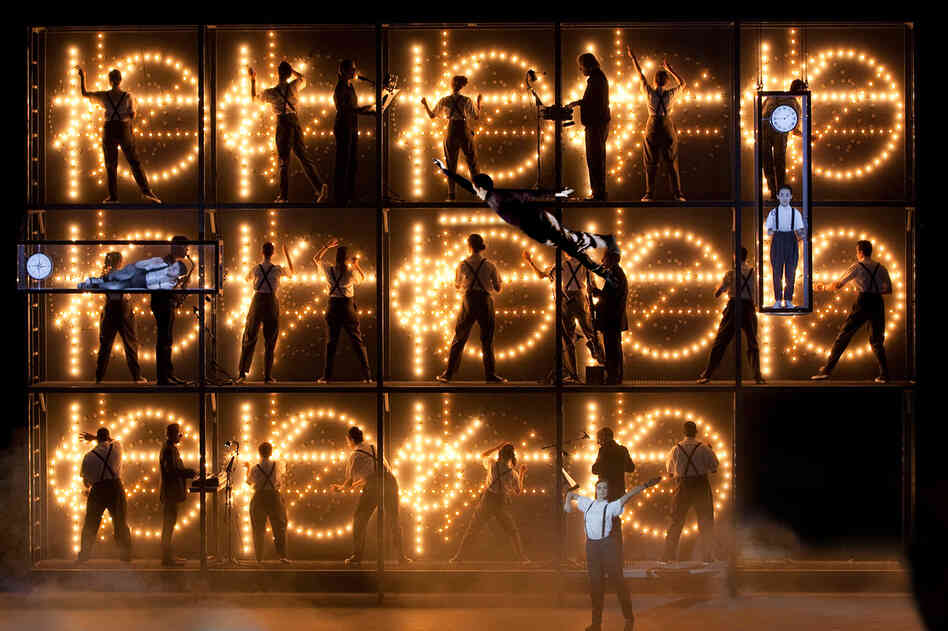
I first experienced Einstein in Mexico City at the Palacio de Bellas Artes (the origin of the banner above) in 2012. Watching a video is, of course, not the same as actually being enveloped by this opera, but it is a rare treat to see in any form. Through blazing beams of light and shocks of red, grand trains and mystical spaceships, singers and dancers in crisp white shirts and suspenders deliver repetitive melodic cycles of movement and libretto for about five uninterrupted hours. Entering this opera means entering another time dimension entirely. Labeled as non-narrative, musicologists tend to think of Einstein as the peak of modernism for Glass; even without a defined plot, it captivates unlike anything else out there.

Most of Houston is already shut inside under a pile of blankets watching bad television and waiting out this cold snap. What’s an afternoon spent enjoying a magnum opus of twentieth-century opera that radically redefined the genre altogether?

Grab a sandwich and settle in: click here for Einstein.