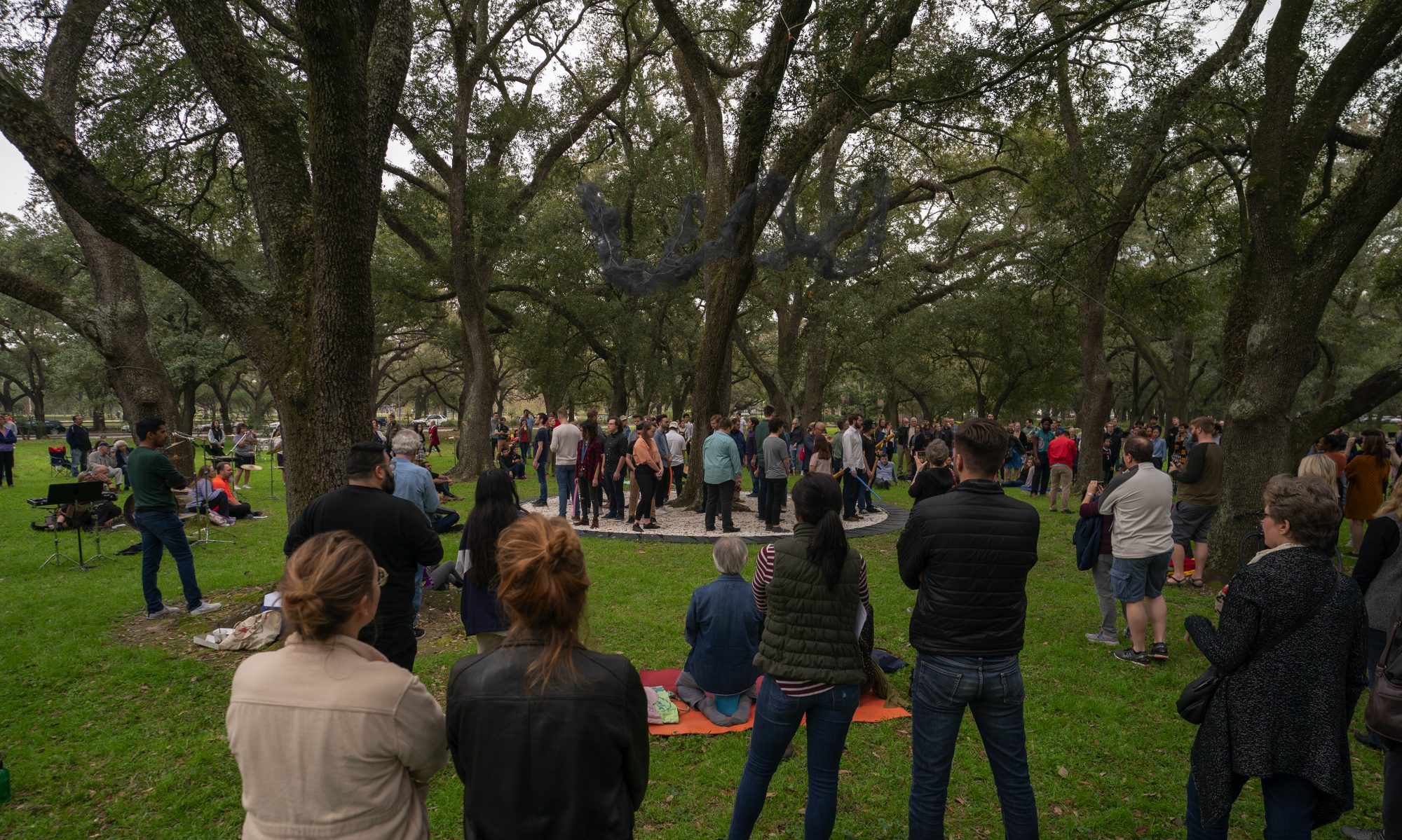
I had a very fun conversation with inter-media artist Klaus Obermaier about his upcoming multi-dimensional staging of Rite of Spring with Houston Symphony. Read my preview at Houstonia Magazine.
ATLAS
Ever since getting my hands on a very bad video of its world premiere here in Houston in 1991, I have dreamed of seeing Meredith Monk’s opera ATLAS for myself. Imagine my joy, then, when I saw that the LA Philharmonic will be reviving it at the end of their season in June 2019. What is a year, when I feel I’ve been waiting a lifetime.
ENGL 397: Capturing Music at Rice
I’m teaching a course this semester on music, writing, and culture in Houston, sponsored by the wonderful Humanities Research Center here at Rice University. After four concerts and five excellent guest speakers, the course culminated with a visit from The New Yorker’s Alex Ross last week. You can read about it on the English department website if you like, but in summary, it was a brilliant visit full of Catherisms, Wagnerisms and other favorite things.
And for the last concert of the semester, Ars Lyrica’s “Italian Sirens,” my students competed in a writing competition hosted by ALH. You can read the winning piece on ALH’s website.
Hurricane Harvey
Yesterday I saw blue sky for the first time in days, and it was a moment of relief, but Harvey will be lingering in Houston for years to come. Among the many traumatic images and stories of suffering, my thoughts are with the Houston Theater District–Houston Grand Opera, Houston Ballet, Houston Symphony, the Alley–that has experienced devastating flooding and loss. It’s a massive blow to our rich, artistic community.
Frank Morgan, comeback legend
At the MFAH this weekend, Sound of Redemption, a documentary about jazz legend Frank Morgan, is making its Houston premiere. His story is about great music as much as it is about overcoming great odds. I had the pleasure of speaking with his sister, Angela, in an interview you can read at Houstonia Magazine.
Remembering Band Camp…
…Actually, the camp I went to was for symphony orchestra, not band, and it’s where I first learned what it meant to play in a string quartet (a shout-out to all Sounds of Summer Music Festival alumni in the Pacific Northwest!).
Read about Houston’s own fantastic AFA Summer Music Conservatory, which just received an NEA grant, at Houstonia Magazine.
Sequence of Sounds: Brandon Bell at Rice University
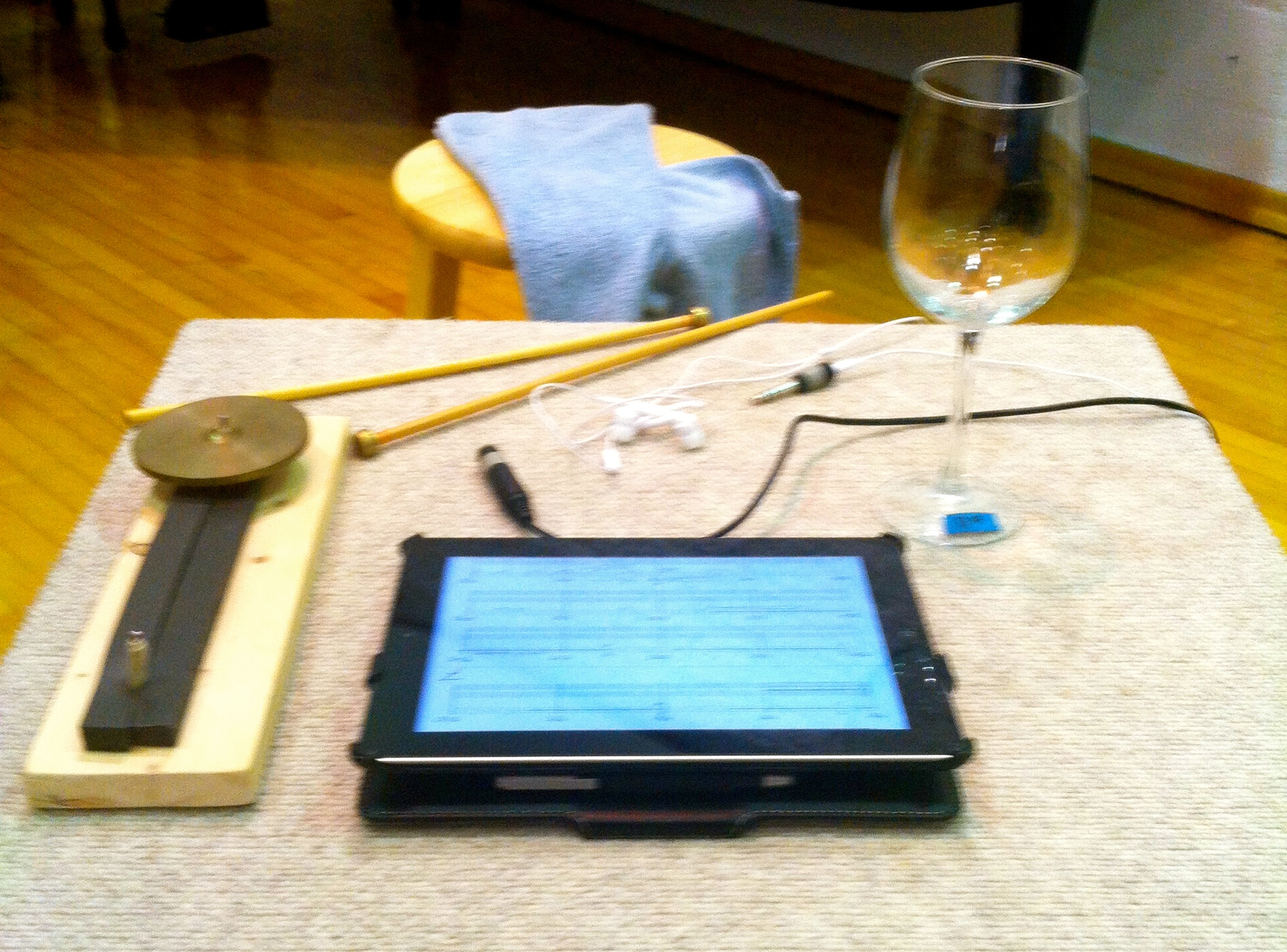
How does sequence affect sound? I wondered this last night watching Brandon Bell move quietly from playing a wine glass with a bow to wringing wet washcloths out on his knees. His dynamic recital in the Hirsch Orchestra Rehearsal Hall, “Plugged In: New Music for Solo Percussion and Electronics,” began with a bell, ended with a flame, and made aural chronology an introspective experience.
Bell is the Malcolm W. Perkins Teaching Fellow at the Rice University Shepherd School of Music, and innovation seems to attach naturally to his work. Last September, for example, he organized the Houston premiere of John Luther Adams’ 2009 “Inuksuit” at the James Turrell Skyspace. Adams, who won the 2014 Pulitzer Prize for the mysterious and epic “Become Ocean,” is rising quickly in the ranks of great American composers, although his work is rarely heard in Houston.
Unwinding sounds, Bell programmed a concert of four premieres. The first, “[relictumne sum]” is a new piece by Ian Power, commissioned by Bell with the support of a Presser Graduate Music Award from Rice. A memorable piece of music will ask provoking questions. [relictumne sum] began with a repeated ringing sound, shifted to a bowed wine glass, and culminated with washcloths and water dripping musically off of Bell’s fingers. It’s an understatement to say the piece was refreshingly evocative. It was followed by Andrea Mazzariello’s “Forms of Practice,” which spiraled rhythm to finally groove into a common time signature.
The icy music of Matthew Burtner, “The Sonic Physiography of a Time-Stretched Glacier,” was stunningly beautiful. Electronic sounds of running water complemented shuddering pulsations from a golden vibraphone, inspiring mercurial visions of liquid. Bell is a serious performer who commits fully without any trace of pretentiousness. In concert, he gives the impression of respecting each sound individually, as if they have come to a peaceful understanding. As he slid a bow against a vibraphone key to end the piece, it was like watching two friends embrace.
Moving from ice to fire, the final piece on the program, “500 Great Things About Wichita,” was described in the program by its composer, Chapman Welch, in the form of a haiku:
ritual click bait
sparks on electric jelly
inside crab orchards
Bell started this piece by slapping his hands against his chest. The stark contrast between electronic sound blaring and the sound of the human body added incredible intention to the aural progression throughout the concert. This piece ended, dramatically, with striking flame from a Zippo lighter. “Sparks on electric jelly / inside crab orchards” lined up with the flickering purple glow. With such attention to the chain of musical sounds—increasingly new and surprisingly radiant—I can’t wait to hear what Bell does next.
“Time and Tension”: Liminal Space rocks Studio 101
Appreciating what some might term “noise” as music brings John Cage and his four minutes and thirty-three seconds of “silence” most readily to mind. But Liminal Space’s season-opening concert of electro-acoustic music recalls an earlier moment in twentieth-century music philosophy: Luigi Russolo’s futurist manifesto The Art of Noises, written in March, 1913. It advocates a shift to accept the sea of sound mankind inhabits, to consider what was previously perceived as “noise” to be a new realm of potential timbre, and to embrace a new musical reality while begging the “modern orchestra” to “Let us go!” This concert, titled “Time and Tension,” offers just such an escape from conventional restraints.
Liminal Space is a contemporary music ensemble in Houston comprised of composer and electric guitarist George Heathco and percussionist Luke Hubley. This concert marks the opening to their second full season, which promises a line-up of Steve Reich, D.J. Sparr, and Orianna Webb. The final concert in May will feature all nine works from a specially-commissioned project Liminal Space created called The New Music Initiative. If the commissioned work performed at this concert is any indication, it’s not going to be a concert to miss.
It’s hard to imagine a lighter way to open a time-and-tension-themed performance than with composer Jacob TV’s The Body of Your Dreams. Arranged for guitar and marimba by Liminal Space, the aural backdrop to this piece is a late-night infomercial for a weight-loss product. The tape, strategically mixed to repeat inelegant but embarrassingly familiar phrases like “Ladies listen to this: that cellulite and flabbiness…that cellulite and flabbiness…” was wildly funny. A dotted rhythm provided some continuity while music and recorded speech spun above it in a strange but groovy combination akin to Robert Ashley’s opera That Morning Thing. A somber mood struck as a voice confessed “I’ve had problems with these love handles on the side.” But the piece picked right back up with success stories and grand promises of finally getting that body you’ve always dreamed about.
The jovial mood of The Body of Your Dreams faded quickly as Heathco scraped his guitar pick down his strings for the night’s world premiere. Written by Hugh Lobel, The Lotus City Songbook is set in three movements and is part of Liminal Space’s commissionary series. The program notes cited an imagined a day in the life of Buddhist figure Bodhisattva Avalokiteśvara, who embodies compassion and listens to suffering of existence. The rhythm swayed between duple and triple meter; hardcore guitar solos rocked over a steady xylophone beat.
Decibel levels, oddly, might have been the breaking point for noise, at least in Russolo’s terms. Percussionist Brandon Bell joined Hubley and Heathco for the last two pieces of the evening, Diving Bell and the two-movement Tension Studies. Diving Bell is scored for amplified triangles with electronics. This translates as two performers bending over two parallel racks of triangles, tapping or scraping the triangles, and then moving a microphone around the instruments. In a nutshell: triangle, microphone, feedback. At times, the feedback became that excruciating screech—the familiar sound of someone awkwardly adjusting a microphone—that makes a person compulsively protect their ears. Moving into Tension Studies, the collaboration of all three performers and their electronics produced a sound that felt like it hit not only your face, but your whole body. In the closing measures, Bell picked up a hammer and pounded a foreign mound of metal.
This closing music wasn’t easy to listen to, but that certainly didn’t make it less awesome. And this sentiment is, in part, what makes Liminal Space a revolutionary ensemble in Houston right now. The first time I heard Liminal Space was at a concert devoted to David Lang’s music last season (Theodore Bale was kind enough to invite me to be a guest contributor about it at his blog). Like this concert, it was a combination of peaceful, humorous work and tumultuous pieces that represent what I would cite as the relentless twentieth-century quest for new music in an old world. Liminal Space brings this tension to Houston, unafraid and unassuming.
Liminal Space’s next concert is December 11 at The Barn—I wouldn’t miss it if I were you. Check out their website for more info: http://liminalspacemusic.com/
Diva on Repeat: Art Installation at Fresh Arts Part 2
A little repetition can be surprisingly refreshing. At a glance, the second part of Soprano Lisa Harris’ performative installment “No Matter How Hard I Try I Can’t Look The Same As I Did Yesterday” seemed identical to the first. But a true performer knows that every performance is unique unto itself—nothing is ever exactly the same.
Titled “Being Alive,” Friday night’s performance is the final part of a two-part installation at Fresh Arts following the first, “Memory,” which was performed September 13. Friday, September 27, will mark the end of the installation with a closing party at Fresh Arts.
The same heavy velvet curtains draping over projections of Liza Minnelli and the same Sondheim bouncing off the concrete surfaces made for an uncanny audience experience—had we all stumbled into the same performance? Simply standing in a different part of the room than last week, I realized when Harris spoke into the mirror, she actually responded to a dialogue in one of multiple sound recordings running through the room: The recording asked “Can you give us a little more attitude” and Harris replied “I’ve got plenty of attitude!”
As an audience member remarked during the closing question-and-answer with Harris, this installation broke its icy separation from the audience with an easy interplay between performer and her audience, even including a sing-a-long with that catchy Streisand classic “People.” The chalk circle of insecurities—“wounding, dismemberment”—still marked the floor, but as Harris looked at her image in the mirror and announced “I’m happy,” it was clear this night was about overcoming those psychological hurdles every performer faces.
Harris stated after the performance she wanted to pull us into her vulnerability. Moving from a retrospective mood last week to “Being Alive,” Harris brought an organic vivacity to something that could have been a blasé repeat. And largely, it had to do with engaging the audience. Is a performer ever really alone on that stage? In Harris’ own words, “We all just did this performance together.”
For more info about Lisa Harris, check this out: http://lisaeharris.tumblr.com/
Behind the Diva: Art Installation at Fresh Arts
Who doesn’t want to know what’s behind the diva? In a performance installation at Fresh Arts titled “No Matter How Hard I Try I Can’t Look the Same as I Did Yesterday,” Soprano Lisa Harris offers a glimpse at what happens behind the scenes—and the mystery is worth the time.
Harris’ Friday night performance, “Memory,” was the first of two installations at Fresh Arts. “Being Alive,” the anticipated second part, will follow on September 20.
Located at the edge of a railroad, the space in Fresh Arts uniquely captures the artistic environment of Houston itself. Those entering the space were greeted by long black velvet curtains draped over the floor, an old baby grand piano, and a vanity surrounded by characteristic light bulbs. A small space without carpet, all sound bounces off the walls, making the space an ultimate site for Harris’ rich soprano voice.
Strategically, the installation revealed the inner consciousness of a performer. Before Harris entered the space, a video projection of her singing “Memory” dressed in a white cat costume as a child hit one wall. On two other walls were a collage of more recent pictures of Harris, dressed and undressed, so to speak, as a performer. In a circle surrounding a pillar in the center of the room were phrases marking the inevitable identity crises of any performer from “Inflated or Heroic Act” to “Wounding, Dismemberment” and “Alienated Ego.”
When Harris did enter the space, she went straight to the piano. Harris looked through Cole Porter sheet music and a Cats score, talking to herself about each piece as though entirely alone. She made no eye contact with the audience, reinforcing the concept that the audience was allowed into a singer’s intimate experience while still invisible. Later, Harris explained she wanted to show the “psychology of the dressing room” where the performer puts on a new identity like one might a new dress.
When Harris moved across the room from the piano to her mirrored vanity, she pulled her audience deeper into her consciousness while repeatedly rehearsing phrases like “Hi, I’m Lisa Harris and I’d like to sing for you today” in the mirror. As she brushed on makeup and threw her hair under a bright, golden-sequined hat, the audience watched itself reflected in the mirror behind her.
Harris took up her last position by her pianist, Kathy Elder, to “warm up” before she presumably took the stage. Opening with “Memory,” Harris’ voice—full of passion and technically superb— inevitably stole this show. After a round with Stephen Sondheim’s “So Many People” and “Send in the Clowns,” Harris brought supreme poignancy to the installation with the Funny Girl Barbara Streisand classic: “People.” While a train rumbled by outside, Harris let this song capture the night’s sentiment as the veil of the performer fell to reveal the person underneath.
The second and final installation happens next Friday, September 20 from 6-8pm at 2101 Winter St. For more info, check this out: https://www.spacetaker.org/culture_guide/event/no-matter-how-hard-i-try-i-can%E2%80%99t-look-same-i-did-yesterday
 Sydney Boyd