“What we see is what we see, and what we hear is what we hear,” Robert Wilson said on March 27, the second night of the three-night Campbell Lecture Series at Rice University. I know Wilson first as the director of the opera Einstein on the Beach. But his theatrical genius extends before and after 1976, when the opera first premiered. Describing his impressive body of work, Wilson focused on a tension between sight and sound winding eventually to a question of meaning. It is by chance that we find a relationship between what we hear and what we see, he explained.
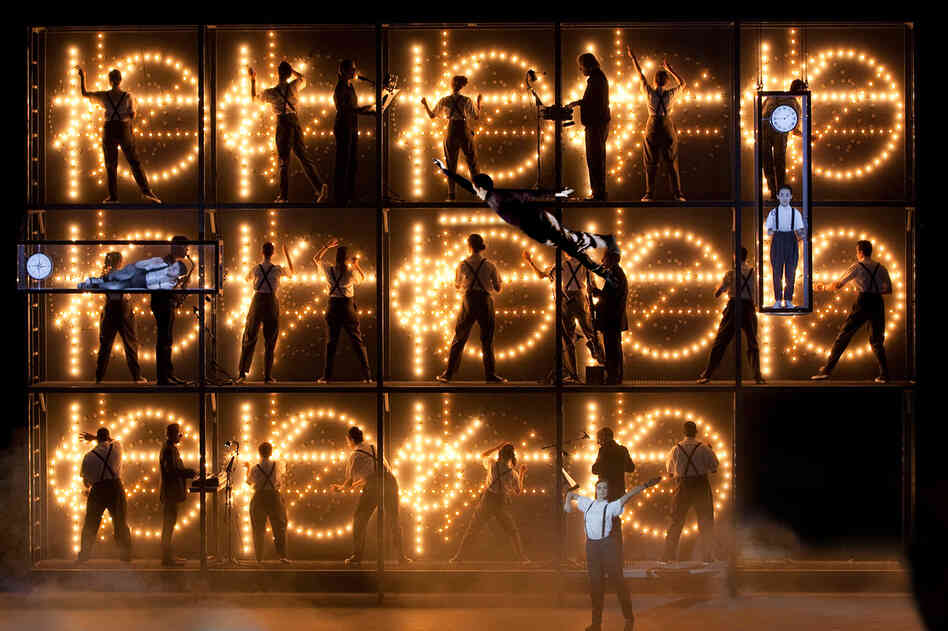
A few hours before this lecture, I had been editing a piece of writing about duration in Einstein’s musical score. While still relying on constraints of time in its compositional structure, the opening of this opera is not built around measures or time signatures. There is a durational relationship at work between three notes: the first A lasts forty seconds, followed by G for sixty seconds, and then a C for eighty seconds. I confess, although I’m embarrassed to admit it, that somehow I had missed the visual score entirely—Wilson’s grid map of time—which, among many things, swings a bar of light from horizontal to vertical in sixteen magical minutes. I’m left wondering now how we see and hear time. Can it be separated? How is the experience different?
To open his lecture, Wilson stood in silence for just over two minutes before telling a story about an architecture professor he had in college in the early 1960s. While she lectured, three screens flashed images behind her which had nothing to do with what she said. After seven or eight months in her class, Wilson remembers that he began to make associations between these unrelated things. One day, she walked to the podium with a black leather handbag, opened it, and took out a fish carefully wrapped in Saran plastic wrap and laid it on the podium. And then she began to talk about Bauhaus architecture without ever mentioning or explaining the fish. At the end of her lecture she wrapped up the fish, put it in her handbag, and left the room. The next day, she brought an orange and set it on her podium. “I’m still thinking about that orange” Wilson said.
Speaking about Einstein, Wilson insists there is no message to get, although this is not the same as saying it is meaningless. And here, again, the building tension between seeing and hearing returns. Wilson strives to create a visual on stage that will sound clearer than if one’s eyes were closed. As a striking example of his investment in a visual score, Wilson described how he staged Wagner’s entire sixteen-hour Ring cycle without the music. The final product was extraordinary.
It feels almost ironic to seek answers to the durational questions Einstein raises in both its aural and visual score. But it is also comforting to be so perplexed by a work. The reason to be an artist, Wilson said, is to ask questions—not say what something is, but to ask “what is it?” And if we know the answer already, it’s not worth doing.
The Campbell Lecture Series in Rice’s School of Humanities brings a distinguished humanities scholar each year to campus. Wilson’s last lecture in the series is tonight, March 28, at 6pm. He promises to speak about his recent work with Lady Gaga. For more info, visit campbell.rice.edu.
 Sydney Boyd