HGO premieres A Christmas Carol with music by Iain Bell and libretto by Simon Callow. It is the worst kind of bad–a boring bad. Read my review at Houstonia Magazine.
In happier holiday news, read my Top 5 classical and opera picks of 2014, also at Houstonia. Cheers to a merry 2015!
Photo by Lynn Lane. Iain Paterson as Wotan, Meredith Arwady as Erda, Andrea Silvestrelli as Fafner, Stefan Margita as Loge, Kristinn Sigmundsson as Fasolt
What is a total work of art? Those familiar with Richard Wagner will jump in first to correct the English with the German “Gesamtkunstwerk” and describe, starry-eyed, Wagner’s vision of a totalizing performance space in which all the arts—architecture, music, poetry—are perfectly fused. But Houston Grand Opera’s Das Rheingold, a co-production with Palau de les Arts Reina Sofia, Valencia, and Maggio Musicale, Florence, makes me wonder if we ever really understood a total work of art until now. Extraordinary doesn’t even begin to describe the experience.
Das Rheingold is the first in Wagner’s epic tetralogy, the Ring Cycle. This opera lays the narrative foundation. As its title suggests, Das Rheingold establishes where the magical gold originates, how it gets forged into a powerful ring, and how it portends the inevitable demise of the gods and Valhalla.
What you might not expect, though, is that this production also establishes that the two giants, Fasolt and Fafner, are supported by 800-pound cranes that come from the same metal shop as Sigourney Weaver’s fighting machine in Alien, and that Loge, the god of fire, is a devil with a Segway. Don’t be surprised to find yourself pondering factory farming as golden forms, hung by their heels, are rolled across the background in an assembly line or reminiscing about the Matrix as golden embryos are packed and sealed against a complex set of data and industrial piping. And I haven’t even gotten to the acrobatics, fire breather, and flying fish tanks yet.
Individually, these elements would be strange (although Loge on a Segway is a stroke of genius no matter what). What set designer Roland Olbeter, costume designer Chu Uroz, lighting designers Peter van Praet and Gianni Paolo Mirenda and video designer Franc Aleu have made together is no less than a visual artistic masterpiece. Architecture: check.
The vocal cast is a power house. The three Rhinemaidens, Andrea Carroll, Catherine Martin, and Renée Tatum, open the opera with a trio de force while still managing to seductively splash around in square, suspended tanks. Baritone Christopher Purves, in the role of the unsightly Alberich, dances around below them while exemplifying vocal agility. As Fricka, mezzo-soprano Jamie Barton tears it up with a voice full of passionate steel. Iain Paterson reigns as Wotan with a mighty bass-baritone—forceful and commanding.
Most memorable of all, tenor Stefan Margita offers an invigorated interpretation of Loge, and it’s not just because he’s floats around the stage on mechanized wheels. Costumed in a shiny white cape lit up with red LED bulbs, Margita leaves an impression. Das Rheingold is the only opera of the Ring Cycle in which Loge plays a major role (later you’ll briefly see him set a ring of fire around Brünnhilde and, later still, light up Valhalla), and it’s a shame. Margita sings purposefully without it feeling purposeful. He is such a good performer it is easy to forget he’s acting. The tenor timbre that so rarely even borders on the fullness that baritones achieve, is, for Margita, a given of breadth and sophistication. I’m tempted to say he is a total work of art himself.
And the orchestra, conducted by the indefatigable Patrick Summers, captures Wagner’s ideal: although there were a few horn blunders, I hardly cared because the score was practically unnoticeable as a separate entity. Music: check.
But the most pressing reason this production redefines Gesamtkunstwerk is that there is poetry in the experience I can’t put into words. It envelopes you and transports you to another land in another time as only a true total work of art can.
Das Rheingold runs April 11- April 26, and many shows are already sold out, so book it now and don’t miss this singular production.
Whose voice do you hear singing “Send in the Clowns?” It has to be Barbra Streisand, doesn’t it? Maybe it’s the more classic Judy Collins or Frank Sinatra. Perhaps the original takes the cake, Glynis Johns? The flashier Judi Dench or Cher? Maybe even The Simpson’s season four rendition by Krusty the Clown? Arguably the best known ballad from Stephen Sondheim’s A Little Night Music, this crowd-pleaser is bound to pick up any show if it has fallen flat. But Houston Grand Opera’s production, created by Opera Theatre of Saint Louis, is superb from the start.
A Little Night Music toys with a rotating trio of mismatched couples. Fredrik, married for the second time to the innocent and much younger Anne, loves the glamorous actress Desiree. But Desiree is having an affair with the high-strung Count Carl-Magnus Malcolm, who is married to the depressed but devoted Countess Charlotte. And Fredrik’s strapping son Henrik, a seminary student no less, is in love with his step-mother Anne—a twisted situation he has no problem gasping about in guilt.
Above all the coy and jealous games, though, A Little Night Music is about women: wives, mothers, step-mothers, daughters, and grandmothers drive this musical. Familiar tropes of working mothers appear early with “The Glamorous Life,” in which Desiree’s young daughter Fredrika sings “Ordinary mothers lead ordinary lives / Keep the house and sweep the parlour / cook the meals and look exhausted” before revealing her mother is anything but the norm, packing and unpacking constantly to keep up her theatre career on the road.
There was no end to the impressive female cast: Soprano Elizabeth Futral, singing the role of Desiree Armfeldt has a deep, smoky tone that won’t let you down—her “Send in the Clowns” held its own against the sea of other renditions. As the virginal Anne, Andrea Carroll wasted no time in showing off her soprano chops—bell-like and unwavering, Carroll’s voice carried across the theatre with charming grace. Mezzo-sopranos Joyce Castle and Carolyn Sproule as Madame Armfeldt and Countess Charlotte Malcolm respectively, each stole a part of the show—especially Sproule’s “A Little Death” that coursed with expression. And as little Fredrika, Grace Muir will be a singer to watch—she was pitch perfect and consistently delightful.
But the men still managed to make an impression. While baritone Mark Diamond played the stuffy part of Count Carl-Magnus Malcolm flawlessly, his voice—a dreamy combination of strength and divine vibrato control—brought unexpected sexiness to his uptight character. Chad Shelton, in the tenor role of Fredrik Egerman, matched Elizabeth Futral’s in charisma. Making his HGO debut as Henrik, Brenton Ryan proved as endearing in character as his voice has talent—he is a tenor I hope to hear again soon.
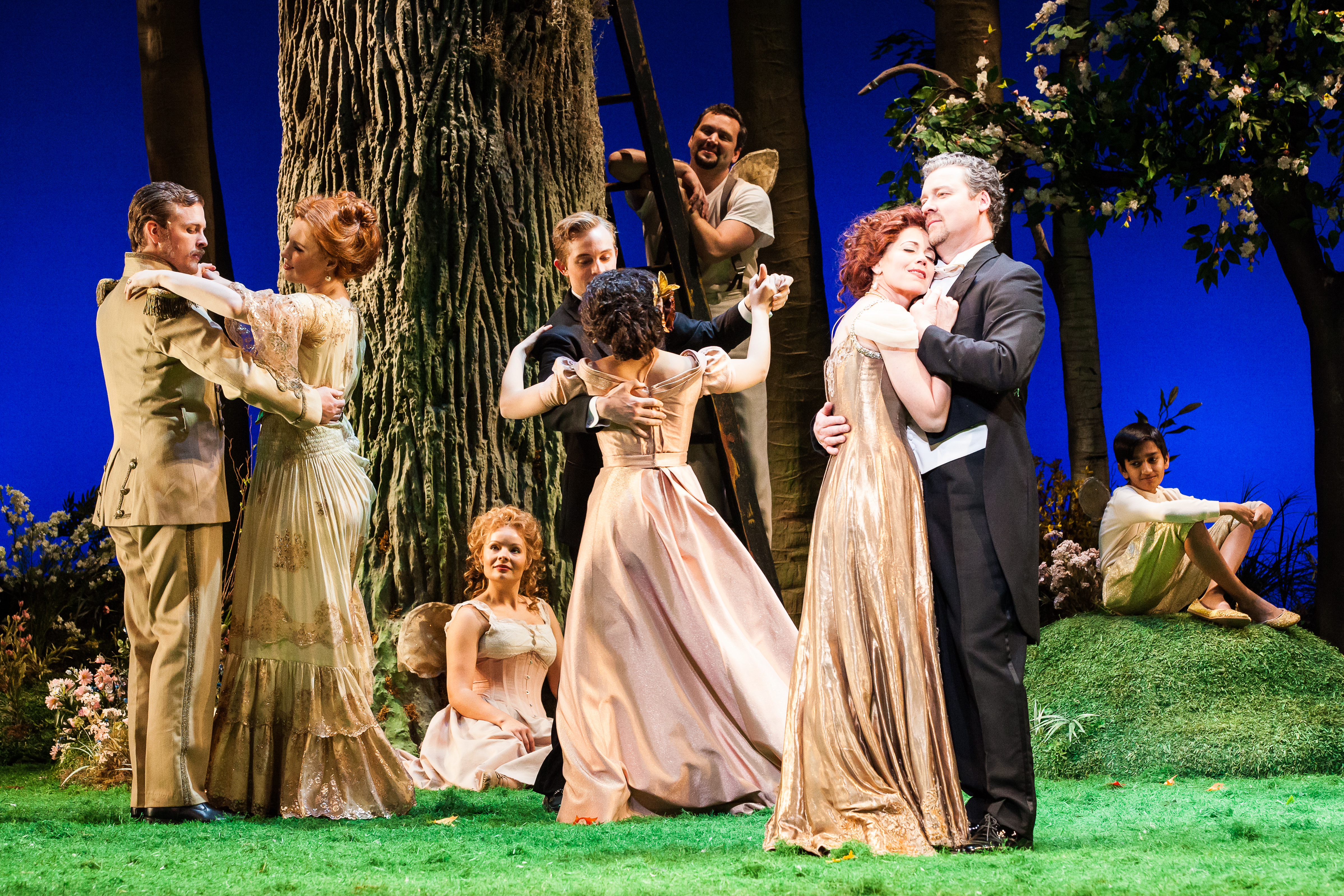
This production might be the best comprehensive piece in HGO’s season so far—the set and singing linked seamlessly. Conductor Eric Melear’s hands danced over Sondheim’s enduring score, capturing the easy essence of language in musical form while the backdrop shifted from bright azure blue to hazy oranges and yellows, cozy greens and brilliant purples. The costumes, cream to begin and flashy gold to end, were the ideal aesthetic pairing to the scenery. Let’s hope we see more from Isaac Mizrahi’s vision for opera in production, set, and costume design.
It is rare but refreshing when a company achieves that level of excellence where everything feels effortlessly stunning. It helps that HGO decided to use the smaller Cullen Theater—I wish the Britten chamber operas had also been moved next door. HGO’s A Little Night Music comes about as close to “just right” as a company can get.
A Little Night Music runs through March 23. For more information or tickets, check out Houston Grand Opera’s website.
Verdi’s Rigoletto is built to be great. Love, revenge, and murder supported by an expert score that anticipates every nuance on stage makes this opera not only beloved, but practically fool-proof. Houston Grand Opera’s Rigoletto, a co-production with The Dallas Opera, leans on the inherent strength of this opera a bit too much. While the singing and set elicited a shrug, a breathtaking third act finally showed HGO’s talent for Verdi.
As if in a whirlwind of genius, Verdi wrote this opera in forty days. Knowing how successful it was going to be, he even withheld the famous “La Donna e Mobile” aria until right before the performance so that it wouldn’t get leaked. And, as he predicted, it blew his audience away at the 1851 premiere in Venice.
The plot is timeless: A barefaced womanizer, the Duke of Mantua runs through as many women in a day as most people do cups of coffee. One woman, after being tossed out by the Duke, dies of shame, and her father flies in a rage to confront the Duke. He is, instead, greeted by the teasing Rigoletto, and the father hurls a curse on his head. The curse works through the second act, and at the close, Rigoletto is holding the dead body of his own daughter—a scene that rarely fails to evoke sensational agony.
Whether due to the cold snap or the quick casting change, the singing was average. Bass-baritone Ryan McKinny, in the title role of Rigoletto, struggled a bit to project. As Kurwenal in Tristan and Isolde last season his voice was an absolute force, but as Rigoletto, his voice and acting came off as stuck. Due to personal reasons, Elizabeth Zharoff was replaced by Uliana Alexyuk as the angelic Gilda. Alexyuk captured the purity of Gilda well—a soprano with a unique bell-like quality—but apart from some supreme high notes, her notes were often flat and her acting without animation.
The exception was Stephen Costello, who ruled brazenly as the Duke of Mantua with a tenor voice of steel. Normally, when a handsome but unprincipled Duke tries the pick-up line “Love brings us closer to angels,” it’s going to end with a drink in his face. Not so with Costello’s voice, which has a golden timbre hard to resist.
The set was underwhelming. An accordion frame-work of squares set the stage. A two-story box rolled in from one side in the second act as Rigoletto’s apartment and from the opposite side in Act Three as the assassin Sparafucile’s shack. The lighting shifted from dim blues, yellows, and reds unremarkably. The most stunning visual effect came in the first few minutes when, during the overture, a shockingly red box opened up in the middle of the stage where Rigoletto was leering at himself in a giant mirror. It set the whole mood of the opera—a violent glimpse of inner consciousness that comes to fruition, finally, in Rigoletto’s closing lines “weeping my life’s blood behind the jester’s mask.”
The last scenes, set off by ominous chimes, revitalized this opera. Conductor Patrick Summers consistently proved his expertise throughout, but here especially, when the emotional mood is already so delicate but charged. When Rigoletto dragged the body bag across the stage, still ignorant his daughter had taken the place of the Duke inside, the chorus hummed that chromatic line so eerily alongside the strings in the same melodic arc that I actually shivered. Whether it was Verdi’s initial genius or the work of this production, the third act—exceptional, despairing, ethereal—was absolutely smashing.
You can catch Houston Grand Opera’s production of Rigoletto January 24 – February 9. For tickets and more info, check out their website.
A beautiful thing is not always easy to watch. Houston Grand Opera opens the new year with the American premiere of Mieczyslaw Weinberg’s The Passenger –a story that moves from a pristine ocean liner to an austere scene in Auschwitz. The program notes describe it, aptly, as “draining” and “unrelenting.” Even so, I noticed more people stayed to watch the final act of The Passenger than had lasted in the more digestable Die Fledermaus earlier this season. There’s a lot of talent and passion behind HGO’s production: for such a traumatic narrative, it proved aesthetically arresting.
A tattered black curtain opens on a bright, white ocean liner where Liese, a former SS officer, catches a glimpse of another passenger. Her husband Walter, a German dignitary, confronts his panicked wife, and she confesses her past and her fear that this passenger might have been her prisoner from Auschwitz. The scene moves back in time to Auschwitz where a doomed love story between two prisoners, Marta and Tadeusz, ends with a wrenching aria about forgiveness, forgetting, and everlasting memories of suffering.
The singing is superb. As Liese, Michelle Breedt is an example of what a mezzo-soprano should sound like: warm in her lower register and rich at the top of her range without ever sounding strained. Soprano Melody Moore, singing the part of Marta, has depth behind her voice that was necessary to portray this character. Her final aria was exquisitely controlled, yet emotionally unbarred. Making his HGO debut in the role of Tadeusz, baritone Morgan Smith made me wish Weinberg had written more for Tadeusz. While some baritones’ timbre can easily become muddled, Smith’s voice rang out consistently with strapping purity.
The visual is divine. Hats off to the creative team behind this production. The stage is divided between the stark silver chrome of the ocean liner above and the dark dismal reality of a concentration camp below, making the quick shifts in time smooth. Lighting Designer Fabrice Kebour deserves special accolades. Rows of spotlights moved like a grid accented by fog that set, rather incredibly, the emotional stage behind the visual. It was class to the core: there was nothing that looked like kitsch, which is more than I can say for the music.
Weinberg’s score is not great. The music that situates the ocean-liner aurally is best described as something that is supposed to resemble jazz. When time shifts back to Auschwitz, the score looks to folk music and Yiddish motifs that feel over-determined. It seemed a bit clever that the strings moved in parallels when the prisoners sang their personal stories, but the score felt overworked in its representation of the narrative, and missed, somehow, setting the characters apart musically in their arias.
In no way did this reflect poorly on the orchestra, though. Conductor Patrick Summers was more animated and enthusiastic than I’ve seen this season. The strings melted the air, especially in the reduced chamber moments. Walking bass and saxophone, despite the lackluster score, managed to insert a disconcerting peppiness to contrast with the horrifying reality of Auschwitz.
Finished in 1968, it’s taken a while for The Passenger to see the stage. Violent scenes, like when a female prisoner is brutally beaten by a group of male SS officers, do not make for light entertainment. While the score and libretto are flawed, the opera stands as an important cultural piece and opens up a narrative that is hard to watch, let alone discuss in an artistic medium. On leaving, I admit I felt frustrated by Weinberg’s score until I noticed a woman still staring at the stage with tears running down her cheeks. Despite the opera’s structural flaws, HGO’s skillful execution of The Passenger calls for pause.
The Passenger runs January 18 – February 2. For information and tickets, visit Houston Grand Opera’s website.



 Sydney Boyd