Smashing Third Act: Rigoletto at HGO

https://dl.dropboxusercontent.com/sh/fveee3dit0mvwyn/iVtArJqIqA/Houston%20Grand%20Opera%20-Rigoletto%20-%20Photographer%20Lynn%20Lane-92.jpg?token_hash=AAG2x5nSWAcKDVdQNBRdr3vsvgRYkVEKG8zWoeH6SBm1pg
Photo by Lynn Lane


Verdi’s Rigoletto is built to be great. Love, revenge, and murder supported by an expert score that anticipates every nuance on stage makes this opera not only beloved, but practically fool-proof. Houston Grand Opera’s Rigoletto, a co-production with The Dallas Opera, leans on the inherent strength of this opera a bit too much. While the singing and set elicited a shrug, a breathtaking third act finally showed HGO’s talent for Verdi.

As if in a whirlwind of genius, Verdi wrote this opera in forty days. Knowing how successful it was going to be, he even withheld the famous “La Donna e Mobile” aria until right before the performance so that it wouldn’t get leaked. And, as he predicted, it blew his audience away at the 1851 premiere in Venice.

The plot is timeless: A barefaced womanizer, the Duke of Mantua runs through as many women in a day as most people do cups of coffee. One woman, after being tossed out by the Duke, dies of shame, and her father flies in a rage to confront the Duke. He is, instead, greeted by the teasing Rigoletto, and the father hurls a curse on his head. The curse works through the second act, and at the close, Rigoletto is holding the dead body of his own daughter—a scene that rarely fails to evoke sensational agony.

Whether due to the cold snap or the quick casting change, the singing was average. Bass-baritone Ryan McKinny, in the title role of Rigoletto, struggled a bit to project. As Kurwenal in Tristan and Isolde last season his voice was an absolute force, but as Rigoletto, his voice and acting came off as stuck. Due to personal reasons, Elizabeth Zharoff was replaced by Uliana Alexyuk as the angelic Gilda. Alexyuk captured the purity of Gilda well—a soprano with a unique bell-like quality—but apart from some supreme high notes, her notes were often flat and her acting without animation.

The exception was Stephen Costello, who ruled brazenly as the Duke of Mantua with a tenor voice of steel. Normally, when a handsome but unprincipled Duke tries the pick-up line “Love brings us closer to angels,” it’s going to end with a drink in his face. Not so with Costello’s voice, which has a golden timbre hard to resist.

The set was underwhelming. An accordion frame-work of squares set the stage. A two-story box rolled in from one side in the second act as Rigoletto’s apartment and from the opposite side in Act Three as the assassin Sparafucile’s shack. The lighting shifted from dim blues, yellows, and reds unremarkably. The most stunning visual effect came in the first few minutes when, during the overture, a shockingly red box opened up in the middle of the stage where Rigoletto was leering at himself in a giant mirror. It set the whole mood of the opera—a violent glimpse of inner consciousness that comes to fruition, finally, in Rigoletto’s closing lines “weeping my life’s blood behind the jester’s mask.”

The last scenes, set off by ominous chimes, revitalized this opera. Conductor Patrick Summers consistently proved his expertise throughout, but here especially, when the emotional mood is already so delicate but charged. When Rigoletto dragged the body bag across the stage, still ignorant his daughter had taken the place of the Duke inside, the chorus hummed that chromatic line so eerily alongside the strings in the same melodic arc that I actually shivered. Whether it was Verdi’s initial genius or the work of this production, the third act—exceptional, despairing, ethereal—was absolutely smashing.

You can catch Houston Grand Opera’s production of Rigoletto January 24 – February 9. For tickets and more info, check out their website.

HGO’s Arresting American premiere: Weinberg’s The Passenger

Photo by Lynn Lane

A beautiful thing is not always easy to watch. Houston Grand Opera opens the new year with the American premiere of Mieczyslaw Weinberg’s The Passenger –a story that moves from a pristine ocean liner to an austere scene in Auschwitz. The program notes describe it, aptly, as “draining” and “unrelenting.” Even so, I noticed more people stayed to watch the final act of The Passenger than had lasted in the more digestable Die Fledermaus earlier this season. There’s a lot of talent and passion behind HGO’s production:  for such a traumatic narrative, it proved aesthetically arresting.

A tattered black curtain opens on a bright, white ocean liner where Liese, a former SS officer, catches a glimpse of another passenger. Her husband Walter, a German dignitary, confronts his panicked wife, and she confesses her past and her fear that this passenger might have been her prisoner from Auschwitz. The scene moves back in time to Auschwitz where a doomed love story between two prisoners, Marta and Tadeusz, ends with a wrenching aria about forgiveness, forgetting, and everlasting memories of suffering.

The singing is superb. As Liese, Michelle Breedt is an example of what a mezzo-soprano should sound like: warm in her lower register and rich at the top of her range without ever sounding strained. Soprano Melody Moore, singing the part of Marta, has depth behind her voice that was necessary to portray this character. Her final aria was exquisitely controlled, yet emotionally unbarred. Making his HGO debut in the role of Tadeusz, baritone Morgan Smith made me wish Weinberg had written more for Tadeusz. While some baritones’ timbre can easily become muddled, Smith’s voice rang out consistently with strapping purity.

The visual is divine. Hats off to the creative team behind this production. The stage is divided between the stark silver chrome of the ocean liner above and the dark dismal reality of a concentration camp below, making the quick shifts in time smooth. Lighting Designer Fabrice Kebour deserves special accolades. Rows of spotlights moved like a grid accented by fog that set, rather incredibly, the emotional stage behind the visual. It was class to the core: there was nothing that looked like kitsch, which is more than I can say for the music.

Weinberg’s score is not great. The music that situates the ocean-liner aurally is best described as something that is supposed to resemble jazz. When time shifts back to Auschwitz, the score looks to folk music and Yiddish motifs that feel over-determined. It seemed a bit clever that the strings moved in parallels when the prisoners sang their personal stories, but the score felt overworked in its representation of the narrative, and missed, somehow, setting the characters apart musically in their arias.

In no way did this reflect poorly on the orchestra, though. Conductor Patrick Summers was more animated and enthusiastic than I’ve seen this season. The strings melted the air, especially in the reduced chamber moments. Walking bass and saxophone, despite the lackluster score, managed to insert a disconcerting peppiness to contrast with the horrifying reality of Auschwitz.

Finished in 1968, it’s taken a while for The Passenger to see the stage. Violent scenes, like when a female prisoner is brutally beaten by a group of male SS officers, do not make for light entertainment. While the score and libretto are flawed, the opera stands as an important cultural piece and opens up a narrative that is hard to watch, let alone discuss in an artistic medium. On leaving, I admit I felt frustrated by Weinberg’s score until I noticed a woman still staring at the stage with tears running down her cheeks. Despite the opera’s structural flaws, HGO’s skillful execution of The Passenger calls for pause.


The Passenger runs January 18 – February 2. For information and tickets, visit Houston Grand Opera’s website.


Putting Lipstick on a Bat: HGO’s Die Fledermaus

Johann Strauss II’s Die Fledermaus should come with a disclaimer: “The operetta you are about to see is where substance meets the void.” Houston Grand Opera’s production, though, does a fine job with an operetta that is itself vacuous. With marvelous sets and robust singing, HGO’s performance made me wonder if I should reconsider this waltzing, drunken affair.

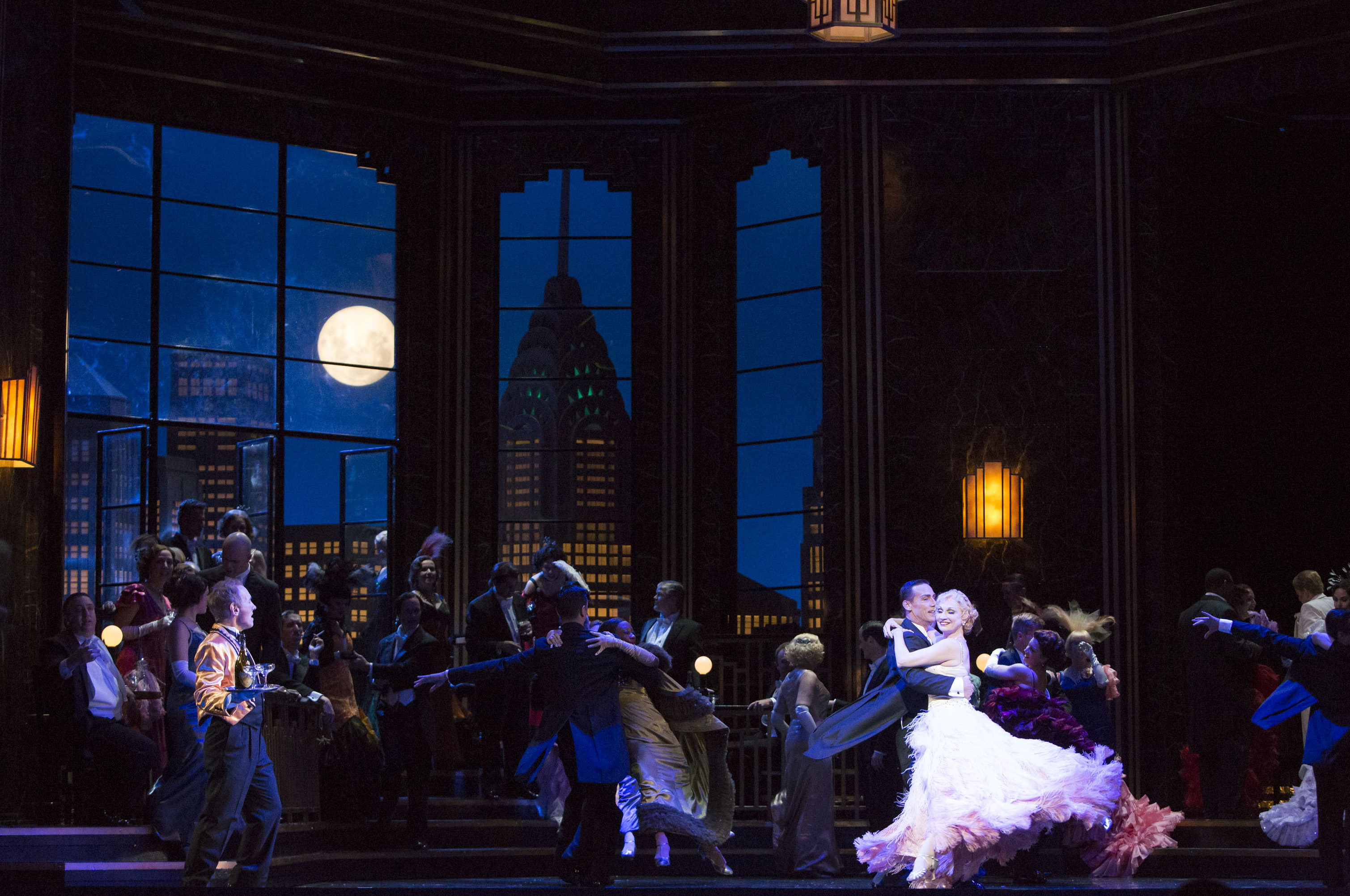
Die Fledermaus follows Verdi’s Aida, which opened HGO’s season last week. Thomas Rösner conducts this production from Opera Australia with attention to the elusive intricacies of the waltz perhaps only an artist straight from Vienna could muster. Set Designer Richard Roberts brings a genuine amount class to this production. Channeling a lavish 1930s Art Deco vibe, the white leather sofas, chrome trimming, zebra-print pillows, tall staircases, and high windows all made for a visual feast. It was appropriately scaled and balanced easily with the other aspects of the production.

Strictly in terms of genre, Strauss’ light operetta drastically differs from Verdi’s grand opera, but both productions prove HGO’s singers are something to hear this season. Soprano Laura Claycomb hammed up the role of wannabe actress Adele with a garish American accent, but her singing betrayed Claycomb as a serious artist. The fullness of her high notes and the accuracy with which her voice danced through Strauss’ ditties delighted and impressed. Making her HGO debut as the dallying Rosalinde, Wendy Bryn Harmer charmed with a smokier soprano timbre, which she played to stupendously in Act II. Apart from yet another gratingly put-on Hungarian accent, her rendition of csárdás was genuinely beautiful.

Baritone Liam Bonner, singing the part of the rascal Gabriel Eisenstein, has a divine instrument—I wish I could hear him sing the role of Billy Budd (which he will with the Los Angeles Opera later this season) instead. Die Fledermaus packs punch after punch of arias that showcase the voice, adding to this operetta’s reputation for light consumption; but how much better it would have been to hear any of these talented artists really dig into a meaty opera by Benjamin Britten.

Strauss wrote Die Fledermaus in a six-week blitz. Critics who are quick to criticize Die Fledermaus as trivial often dangle the fact that the original production in April 1874 was cancelled after only sixteen performances. But this was not because Strauss was too hasty or careless in his composition; in fact, it was only pulled off stage because of a pre-booked visiting opera, and Fledermaus made an extremely popular return to the Theater an der Wien in Vienna. And, as a quick browse through operabase.com shows, it persists today as a fashionable choice and an audience favorite. Since 2012, it has seen 535 performances of 121 productions in eighty-six cities. Britten’s Billy Budd  has only found its way to thirty-four performances of five productions in five cities in the same time bracket search.

These shocking (and, in my opinion, sad) statistics ask a larger question: why do audiences love Fledermaus so much? It’s not because of any semblance of poetic language. Though its libretto has seen many translations, HGO’s production uses the English text. Lines like “a night of allusion / happy in our delusion” and “Kling kling kling sing sing sing” got old fast, though admittedly its German standard isn’t much better: “Ja, sie hat Recht, gehn Sie hinaus / Sonst wird noch ein Skandal daraus!” The score—an endless triple meter—is an unwelcome waltzing mass still whirling through my head. No tonal risks, no harmonic surprises. Really, nothing to spike my blood pressure.

As the program notes emphasize, Die Fledermaus hit Vienna right after a devastating depression and seemed to lift society’s spirits, or at least distract them for a moment in the theatre. Prince Orlovsky urges his guests to embrace delusion and drink up, sinking into memories of being young and frivolous. Everyone ends with a glass of champagne in their hands to perpetuate the farce. Sure, reality bites. Is that anything new? There’s validity in distraction, but if distraction is the point, shouldn’t more artistic tact be employed to sustain the illusion?

Repeatedly, Die Fledermaus shows self-awareness of being a lowbrow spectacle. Rosalinde’s warning “Don’t remove the mask I wear or you will see a sight you cannot bear,” echoed on a wider plane. When the lights came up on the “pretentious” opera audience in Act III, it felt like getting caught red-handed watching Keeping up with the Kardashians.

HGO presents a technically proficient rendition of an operetta that is what it is. HGO promises Stephen Sondheim’s intrepid musical A Little Night Music later this season as a complementing alternative to “high” opera. Sondheim’s work might prove a more worthy context for HGO’s admirable execution.


Die Fledermaus runs Oct 25 – Nov 10. For tickets and more info, check out Houston Grand Opera’s website.

The extensively featured Viennese Waltz. Photo by Felix Sanchez

HGO’s Aida: Exquisite Singing, Geometric Dying

Verdi built balance into Aida. The four-act plot balances with the steady musical structure; exoticism miraculously balances with the universal trope of love. Houston Grand Opera celebrates Verdi’s bicentennial this year, opening its 2013-2014 season with Verdi’s beloved opera. Stunning singing battling against an overpowering set, though, proved that great parts do not always make a synchronized whole.

Aida –a co-production with English National Opera, San Francisco Opera, and Norwegian National Opera–begins HGO’s 59th season that remembers not only Verdi’s bicentennial, but also Wagner’s.  Das Rheingold, the first installment of the Ring Cycle, closes out the season that promises some rewarding Weinberg and Sondheim in between. Strauss’ Die Fledermaus follows most closely, opening October 25.

The triumph of this production was Soprano Liudmyla Monastyrska who makes her HGO debut in the role of Aida. “O patria mia,” her big aria in Act III, inspired an enthusiastic chorus of bravos from the audience. In the aria, Aida laments the loss of her country and contemplates death in the Nile. It ranges from powerfully loud notes to whisper soft phrases—both difficult extremes to successfully pull off. Not only is it technically impressive, but the aria is built to be emotionally fraught. Although the key is F major, Verdi’s orchestration creates a “false tonic” of A minor. The height of the vocal line is a high C. Monastyrska’s vocal instrument proved its versatility here. Hers is a voice with breadth. She can achieve emotional intensity in any range, at any dynamic; that said, Monastyrska won me over (and, it seemed the whole house), when her voice was at its softest.

Joining Monastyrska in vocal excellence was Tenor Riccardo Massi as the dreamy Radames and Mezzo-Soprano Dolora Zajick as the jealous Amneris. Massi is a rare combination of voice and looks—both supremely perfect for the role of the Egyptian champion who inspired two princesses to fall madly in love with him. The timbre of his tenor voice is far from thin—a tricky thing to achieve when the score insists on such high notes. Consistently, Massi’s swarthy voice reached the height of scales easily. Zajick, in the role of Amneris, realized the complex character of a woman who inspires both sneering and sympathy. The ending relies on Amneris, the grieving lover outside the tomb, to bring closure to a tragic double-death. Equipped with a full mezzo instrument, Zajick brought the curtain down with class.

Mere weeks before Aida premiered in Cairo, Egypt on December 24, 1871, Verdi found himself at the first Italian production of Wagner’s Lohengrin in Bologna. While he enjoyed the prelude, musicologist Julian Budden writes that Verdi found much of it excessive from the slow-paced dialogue to the sustained pedal points. He was understandably upset when critics compared his operas to Wagner’s. After Aida’s premiere, one critic wrote “to deny that Verdi has been influenced by Richard Wagner is like denying light to the sun.” Verdi obsessively set to manage subsequent productions, making sure the instruments and sets adhered to his original directions—surely misinterpretation was the reason he had egregiously been compared to Wagner.

Yet, Wagner’s influence persists in HGO’s production. Given how much Verdi worried about the set, I imagine he would have balked at what Set and Costume Designer Zandra Rhodes conceived for this production. Rhodes captured an unfortunate side of Wagner’s totalizing theory for opera in the set: an obsessive affinity for triangles, hieroglyphics a four-year-old might have drawn, and creations pulled straight from Dr. Seuss’ Horton Hears a Who!. I couldn’t look away, but I wanted to. The pyramid-like triangles persisted as though someone were afraid the audience might forget the opera was set in Egypt. This continued through to the end when a series of triangles forming the tomb actually closed in to signal suffocation for Radames and Aida, who weren’t the only ones feeling like Desdemona in a geometric death. The color palette could have been brilliant—a bright blue, gold, and orange appeared like sigh of relief in a simple gradient screen in the last act (see photograph below by Lynn Lane). Though the backdrop was framed by those pesky triangles, it hinted at what this set could have achieved. With such strong singers and Verdi’s masterly score, this production didn’t need flashy sets.

Abounding in symmetry, Aida balances on a delicate operatic scale. The phrases are even eight and sixteen bar passages without much leeway; the libretto of Aida’s striking Act III aria is two-fold, breaking with the traditional couplet writing and instead returning in rounds to “O patria mia.” A critic who saw the original Cairo production wrote “No one who concerns himself seriously with art has failed to notice in Aida a strange duality.” It is, then, incredible to overturn this inherent balance. Aida’s renown relies on its magnificent music. A pity this production’s overworked sets tip the scale to outweigh Verdi’s brilliant composition.

Houston Grand Opera’s Aida runs Oct 18 – Nov 9. For tickets and more information, visit its website here.

Photograph by Lynn Lane
My favorite triangle, though there were many. Photo by Lynn Lane.